Commercial Real Estate in NCR, Residential Retreats in Gujarat & Uttarakhand: What Investors Should Know in 2026
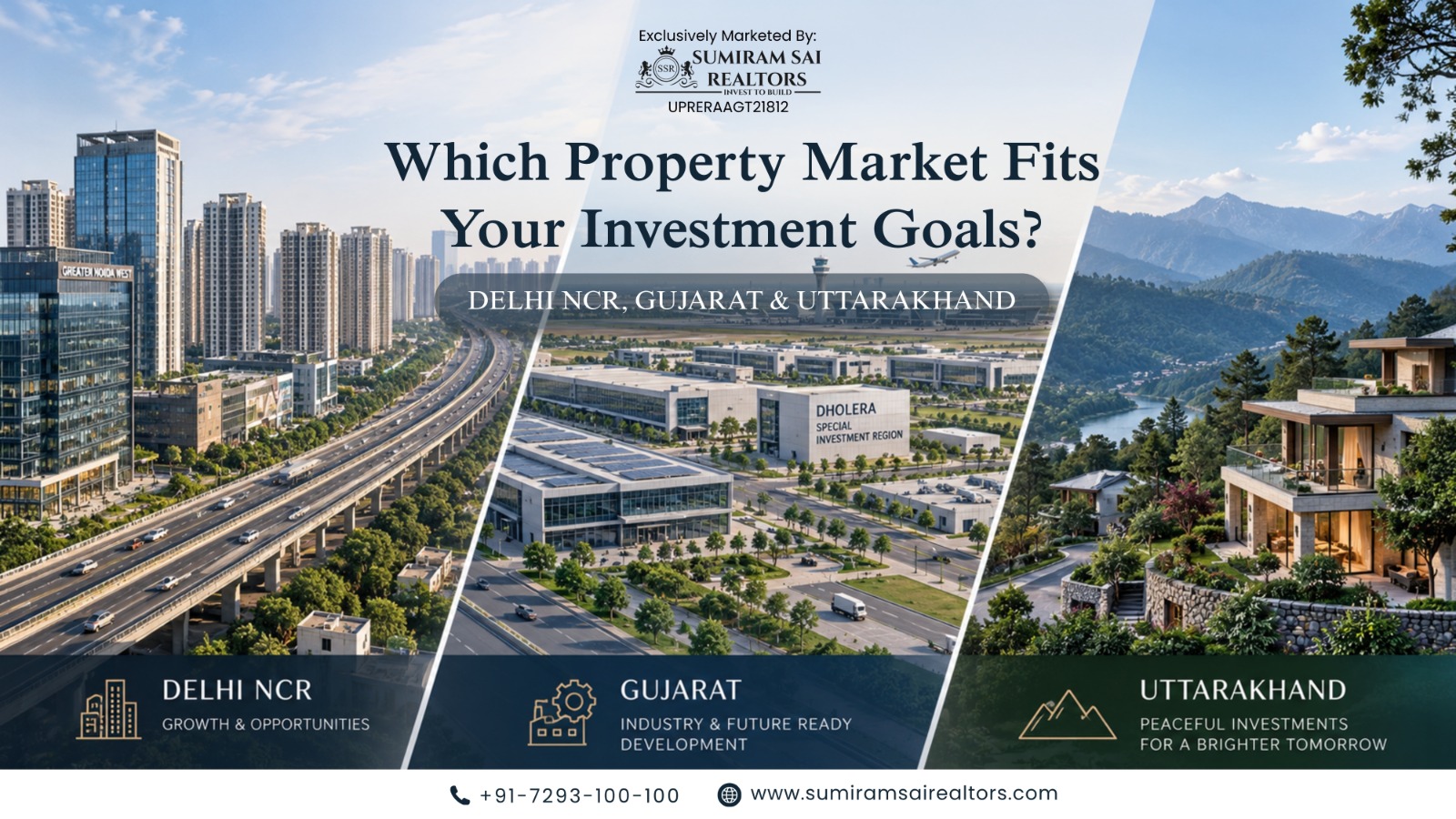
Real estate in India isn't one market — it's dozens of very different ones, each moving at its own pace and rewarding a different kind of buyer. Delhi NCR's growth corridors — Ghaziabad, Noida, Greater Noida, and Greater Noida West — are increasingly being shaped by commercial property demand: retail shops, food courts, and offices built to generate steady rental income. Meanwhile, Gujarat is building an entirely new industrial and residential city from scratch, and hill towns in Uttarakhand are quietly becoming second home destinations for buyers who want a weekend retreat without a long flight.
This guide walks through what's actually happening in each of these regions right now — commercial opportunities across NCR, and residential opportunities in Gujarat and Uttarakhand — along with the questions worth asking before you commit. This is general market information, not investment advice, and it comes with no promises of guaranteed returns. Property values move with local infrastructure, demand, and timing, and any of these can shift.
NCR's Commercial Corridor: Ghaziabad, Noida, Greater Noida & Greater Noida West
Delhi NCR remains one of India's most active property markets, and within it, the commercial segment — retail units, food courts, and small offices — has been gaining ground as buyers look for passive income through commercial property rather than purely residential holdings. The appeal is straightforward: a retail shop or food court unit in a busy catchment can generate rental income month after month, without requiring the owner to actively run a business themselves.
Commercial Property in Ghaziabad
Commercial property in Ghaziabad has picked up noticeably along the NH-24 corridor, particularly around townships like Crossing Republik, where dense residential populations create steady daily footfall for retail and food-based businesses. Projects positioned here — combining retail space with a food court format — are designed to capture two kinds of demand at once: shoppers who need daily convenience, and diners who stay longer once they're inside.
For a buyer specifically comparing shop for sale in Ghaziabad options, the factors that matter most are the same ones that matter anywhere: how many households sit within easy walking distance, whether the surrounding township is already occupied or still filling up, and whether the project carries a valid RERA registration. A food court investment here tends to appeal to buyers who want rental income without the operational complexity of running a full standalone restaurant themselves.
Commercial Property in Noida
Commercial property in Noida covers a wide range — from established business districts like Sector 62 and Sector 16, to newer retail-led developments closer to residential sectors. Noida's advantage is its maturity: metro connectivity, a large working population, and established commercial catchments that don't depend on future infrastructure promises. That maturity, though, usually comes with higher entry prices than newer corridors nearby.
Buyers evaluating retail space investment in Noida often weigh this trade-off directly against Ghaziabad or Greater Noida West — paying more for proven footfall here, versus paying less for a still-developing catchment elsewhere.
Commercial Property in Greater Noida
Commercial property in Greater Noida, particularly around Knowledge Park, follows a different demand pattern than pure retail corridors. Knowledge Park is built around institutions, IT and ITES companies, and educational campuses, which makes it more relevant for office space, coaching-linked commercial units, and hospitality catering to students and visiting professionals — rather than daily convenience retail. A passive income strategy here usually leans toward long-term commercial leasing to institutions or businesses, rather than short-cycle retail turnover.
Commercial Property in Greater Noida West
Commercial property in Greater Noida West has grown alongside the area's residential boom. As more households moved into sectors like Sector 1 and Techzone 4, ground-floor retail and small commercial units nearby began seeing steadier footfall — a pattern that typically follows residential density with a lag of a few years. Infrastructure projects like the proposed Shahberi flyover and the Aqua Line metro extension toward Gaur Chowk (currently under tender) are expected to improve access further, which tends to support commercial catchments once completed.
For commercial property in Greater Noida West specifically, it's worth evaluating actual household density within walking distance rather than relying on headline price-per-square-foot figures alone — a smaller, well-located unit inside a filled residential pocket can often outperform a larger unit in an area still filling up.
Passive Income Through Retail and Food Court Investments
Across Ghaziabad, Noida, Greater Noida, and Greater Noida West, the common thread for commercial buyers is passive income through commercial property — owning a retail shop or food court unit and earning rental income from it, rather than actively operating a business. A few things typically influence how well this works in practice:
- Occupancy and tenant mix — a fully leased project with recognizable brands tends to generate more predictable income than one still filling vacant units.
- RERA registration — verifying the project's registration number on the official state RERA portal confirms basic transparency around approvals and timelines.
- Rental yield range — commercial units, including food court formats, often carry higher potential rental yields than residential property, though the exact figure depends on location, footfall, and market conditions rather than being fixed or guaranteed.
- Operational complexity — food court units generally involve less day-to-day management than a standalone restaurant lease, since shared common areas and facilities are typically handled by the mall or project management.
None of this guarantees a specific return, and rental income depends on how quickly a project fills up and how consistently footfall holds over time.
Gujarat: Dholera SIR and the Case for Residential Plots
Dholera sits in a very different category from NCR's commercial corridors. The Dholera Special Investment Region covers about 920 square kilometres in Ahmedabad district, roughly 100 kilometres southwest of the city, and was launched in 2011 as part of the Delhi-Mumbai Industrial Corridor. While it's being built primarily as an industrial and manufacturing hub, planned residential plots are following alongside it — aimed at buyers thinking in a longer time horizon than a typical NCR purchase.
Recent progress has been notable: a successful trial landing at the under-construction Dholera International Airport, rapid construction of a large semiconductor fabrication plant nearby, and the Ahmedabad-Dholera Expressway reported to be around 95% complete. Core utilities — water treatment, sewage treatment, ICT infrastructure, and a 300 MW solar park — have already been completed.
This is why real estate investment in Gujarat, and specifically residential plots near Dholera, tends to attract a different kind of buyer than NCR's commercial market — someone comfortable waiting 5 to 10 years for the surrounding industrial base to mature, rather than looking for immediate rental income. Treat the airport's cargo and passenger timelines, and the pace of industrial occupancy, as the milestones to track — not just the headline land price. Early-stage industrial cities can move fast once anchor industries commit, but they can also stay slow for longer than expected.
Uttarakhand: Villas and Residential Plots as a Second Home
Villas for sale in Uttarakhand and residential plots in Uttarakhand appeal to a different buyer entirely — someone who wants a retreat, not a rental-yield spreadsheet. Towns like Nainital, Mussoorie, Dehradun's outskirts, and the Kumaon belt (including emerging pockets like Kashipur and Ramnagar near Jim Corbett National Park) have seen growing interest from NCR and other metro buyers looking for a place to disconnect on weekends or during summer.
What's Driving Second Home Demand in India
The idea of a second home in India has moved beyond pure luxury. A mix of factors is behind this:
- Remote and hybrid work means a second home can double as an occasional working retreat, not just a holiday spot.
- Better road and air connectivity has shrunk travel time to hill towns that used to feel remote.
- Generational wealth transfer — many younger buyers are purchasing a second property earlier than their parents did, often as a long-term family asset rather than a quick flip.
When people ask about the best cities for a second home in India, the honest answer depends on purpose — a hill station for weekend escapes, a coastal town for retirement plans, or an NCR-adjacent location reachable within a couple of hours for regular use. It's worth being clear on which of these you're actually buying for before comparing locations.
Questions to Ask Before Buying — Commercial or Residential
Whether you're looking at retail space in Greater Noida West or a residential plot near Dholera or in Uttarakhand, a few questions apply everywhere:
- Is the title clear? Ask for the chain of ownership documents and get them checked by a lawyer, not just the seller's word.
- What's the RERA registration status? For most residential and commercial projects in India, verify the registration number directly on your state's RERA portal.
- What's the actual possession timeline, and what happens if it slips? Ask about penalty clauses for delays rather than accepting optimistic dates at face value.
- What infrastructure is promised versus already built? A metro line "under tender" is not the same as a metro line running.
- What are the ongoing costs? Maintenance charges, society or association fees, property tax, and — for commercial units — common area maintenance specifically.
- Who else is developing nearby? Neighbouring projects can affect footfall (for commercial units) or view and resale value (for residential ones).
- What's the exit plan? Understand how liquid, or illiquid, that specific micro-market tends to be before assuming you can sell quickly if needed.
Investing With Realistic Expectations
No property, sector, or city offers guaranteed returns, and anyone promising otherwise should be treated with caution. What actually moves property values and rental income over time is usually a combination of infrastructure delivery, footfall or employment growth in the area, and simple supply and demand. NCR's commercial corridors, Dholera's industrial buildout, and Uttarakhand's second-home demand each carry different types of opportunity — and different types of risk and waiting periods. The right fit depends on your own timeline, purpose (using it, renting it, or holding it long-term), and how much uncertainty you're comfortable with.
Working With a Local Partner
Markets like Ghaziabad, Noida, Greater Noida, Greater Noida West, Dholera, and the Uttarakhand hill belt all reward buyers who actually know the ground reality — which sector already has water and power connections, which project has genuinely started construction versus one that's still just a brochure, and which locality's "upcoming metro" is realistically years away. That's the kind of on-the-ground clarity a firm like Sumiram Sai Realtors aims to bring to buyers and investors, whether you're looking at a commercial property in NCR for passive income, or a residential plot or villa in Gujarat or Uttarakhand for the long term.
Frequently Asked Questions
Is commercial property in Ghaziabad a good option for passive income?
It can be, particularly in catchments with strong residential density like Crossing Republik. Passive income depends heavily on occupancy and tenant mix, so checking a project's current leasing status before buying is more useful than relying on projected yield figures alone.
What's the difference between investing in commercial property in Noida versus Greater Noida West?
Noida generally offers more established, proven footfall at a higher entry price, while Greater Noida West offers lower entry pricing in a still-maturing catchment. The trade-off is between paying more now for certainty, or paying less and waiting for the area to fill in.
Is a food court investment better than a standalone retail shop for passive income?
Food court units typically involve lower day-to-day operational complexity since common facilities are usually managed by the project, while a standalone retail shop may require more direct involvement from the owner or a longer-term lease negotiation. Neither guarantees a fixed return — both depend on footfall and occupancy.
What makes Dholera SIR different from a typical residential investment?
Dholera is an industrial city being built from the ground up, so residential plots there are a longer-horizon investment tied to industrial occupancy and infrastructure completion, not an established residential market with immediate rental demand.
Are villas or residential plots in Uttarakhand a good investment or mainly a lifestyle purchase?
For most buyers, they're primarily a lifestyle purchase — a retreat or weekend home — with any appreciation being a secondary benefit rather than the main reason to buy.
How do I verify if a commercial or residential project in NCR is RERA registered?
Search the project name on your state's official RERA portal (UP-RERA for Ghaziabad, Noida, and Greater Noida projects); the registration number and project details should be publicly listed there.
Is now a good time to invest in commercial property in NCR, or wait for more infrastructure to complete?
There's no single right answer — buying earlier in a developing corridor can mean lower entry pricing but a longer wait for footfall to mature, while buying in an established area means more certainty but typically higher prices. It depends on your own timeline and risk comfort.