Is Mahagun Metro Mall in Vaishali the Right Location for Food Court Space?
A location guide for buyers weighing the buy-and-receive-rental food court plan at an operating mall
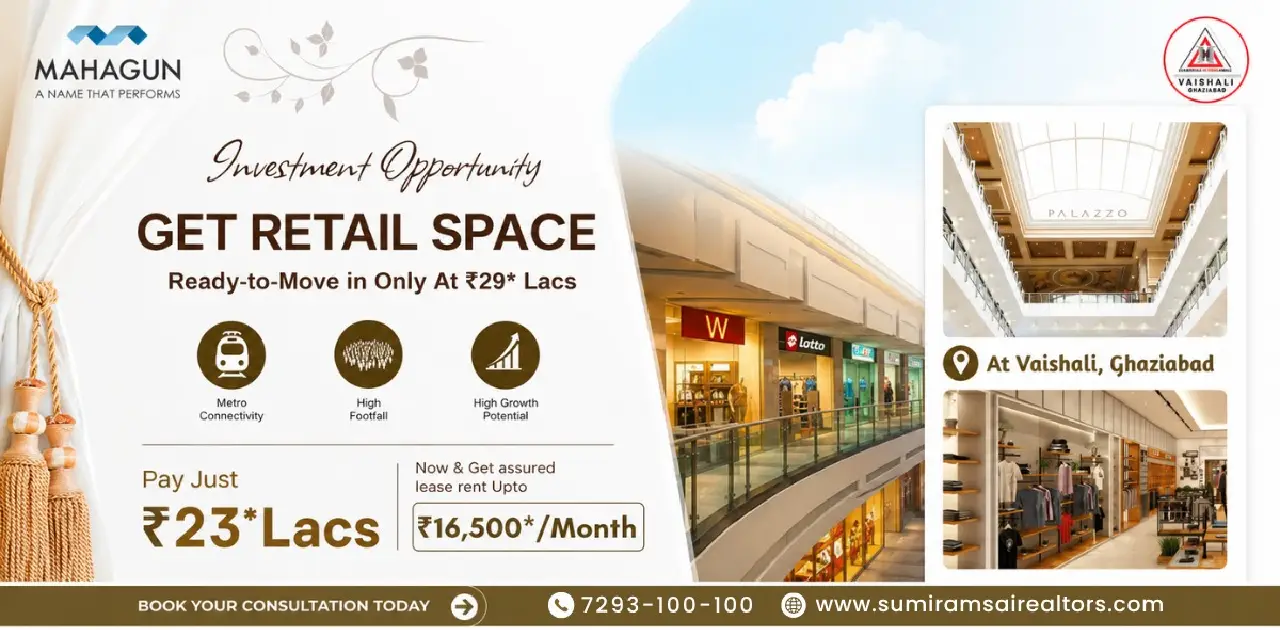
Mahagun Metro Mall has several things going for it as a food court location: it is an operating mall in Vaishali, Ghaziabad, built by the Mahagun Group, in a part of the city served by the Delhi Metro's Blue Line, and its design firm describes a food court, a multiplex, a hypermarket, a serviced-apartment block and offices under one roof. Whether that makes it the right place for your money depends on how you weigh transit footfall, catchment, the mall's current health and the terms of the plan itself.
The plan, as the sales team explains it, works like this: you buy food court space, you do not run it, and rental is paid to you monthly under the agreement. This page does not repeat the plan step by step, which is covered in our guide to how food court space works at The Core Mall. It concentrates on the question that comes next: is this particular location a sound base for that plan? Prices are left out on purpose and should come from a current written price list.
To ask about available units, the plan terms and the agreement: use the enquiry form on this website.
Mahagun Metro Mall at a Glance
| Detail | What the sources say |
|---|---|
| Location | Vaishali, Ghaziabad, Uttar Pradesh |
| Developer | The Mahagun Group |
| Status | Built, according to the design firm's project credits |
| Components described | Food court, PVR-run multiplex, hypermarket, serviced apartments, corporate offices |
| Nearest metro | Vaishali station on the Blue Line (distance described differently, see below) |
| Food court plan | The sales team explains that a buy-and-lease food court plan is offered here |
The component list comes from the design firm's own project listing, so it describes the mall as designed. Check what trades there today when you visit.
The Plan at This Mall, in Short
You buy a unit in the mall's food court area. A tenant or operator trades from it, a management arrangement looks after the tenant side, and rental is paid to you each month according to your agreement. The amount, the start date, how long it runs and how it changes are all things the agreement should state.
Public pages for this mall do not publish rental terms or unit details. The sales team's description is where the plan comes from, so every point should be confirmed in the documents. For the detailed questions, such as who pays, what happens if the operator leaves and when rent starts, use the checklist in our guide to the plan at The Core Mall.
Reading the Location: Vaishali and the Metro
The metro link
Vaishali is a Blue Line station on the Delhi Metro, and a mall near a metro station can draw a steady flow of commuters. For a food court, that kind of footfall tends to matter most around lunch and early evening, when people are on the move and want something quick.
The distance between station and mall is described differently by different sources. Some descriptions say the station exit leads toward the mall, while a metro-distance listing gives roughly a 15-minute walk. Do not settle this from a page. Walk it yourself from the station exit, note the route, the road crossings and how a visitor would find the entrance, and judge whether a tired commuter would actually come in.
The catchment as marketed
The sales team's material names a catchment that includes Vaishali's sectors, Kaushambi, Indirapuram, Raj Nagar Extension, Crossings Republik and Noida Sector 62, grouped by distance. These are marketing groupings, not audited footfall figures, and the material gives no visitor counts. Use them as a list of places to think about, not as proof of demand.
Transit footfall and destination footfall
A mall can draw people because they pass through, or because they decide to go there. Transit footfall is steady but can be hurried. Destination footfall is slower to build and spends more time, which usually suits family dining and weekend meals. A food court generally does best when both are present. When you visit, notice which kind you are seeing.
Vaishali as a Commercial Address
Vaishali is an established residential area of Ghaziabad close to the Delhi border, with housing societies, markets and offices around it. For a mall, an established neighbourhood cuts both ways. There is a ready base of nearby residents who can visit often, and there is competition from the shops, eateries and other malls that have grown up around them.
Both points are worth testing on the ground. Walk the streets around the mall, see what else serves food within a few minutes' walk and ask why a diner would choose the mall's food court over those options. A good answer might be air-conditioned comfort, variety, parking, safety after dark or the pull of the multiplex. A weak answer is a reason to ask more questions.
Common misreadings of metro proximity
- "Near a metro station means busy." Proximity gives a food court potential, not visitors. What counts is how many commuters actually step inside.
- "The exit leads to the mall, so people will walk in." Whether they do depends on the route, signage, weather, safety and whether there is something inside they want.
- "Commuters are diners." Many commuters are heading home to eat. Check the orders being placed, not the number of people passing.
Why Timing Matters: A Week in the Life of a Food Court
Food courts do not fill evenly, and understanding the rhythm explains why one visit is never enough.
Weekday lunch is usually driven by office workers, students and people running errands. Orders are quick, seating turns over fast and price sensitivity is high.
Weekday evening mixes commuters heading home with families and groups. This is where metro footfall can matter most.
Weekend afternoon and evening is where destination visits show up: families, friends and people combining a film or shopping with a meal. Seating pressure is usually highest here.
Festivals and school holidays can change the picture again, and so can weather, exams and local events.
A food court that is busy at only one of these times may support operators less well than one with steady use across several. When you compare notes from your visits, look at how many of these windows are healthy, not just the busiest one.
What an Operating Mall Lets You Do
The biggest advantage of an operating mall over a new project is that you can watch it work. Most buyers never do this properly, so here is a simple method.
- Visit at three different times. Go on a weekday lunch, a weekday evening and a weekend afternoon.
- Count, don't guess. Stand at the food court entrance for ten minutes at each visit and note how many people go in and how many leave.
- Look at the seating. Are tables occupied, or do people carry trays and wander? Is the seating clean?
- Check queues and trading outlets. Which counters are busy, which are quiet and which are shut?
- Follow the route. Walk from the metro station and from the parking area to the food court, and note how easy it is to find.
- Compare floors. See whether visitors reach the food court level, or stop at the lower floors.
Is the Food Court Itself Well Placed?
A good building can still have a poor food court. These points are worth checking in person:
- Position: is the food court on a floor people naturally reach, or tucked away?
- Visibility and signage: can a visitor find it without help?
- Links to other draws: the design firm describes a multiplex and a hypermarket, and a food court near them can benefit from those visitors. Confirm that those parts are open and busy.
- Seating and layout: is there enough common seating for peak hours, and who manages and cleans it?
- Access and parking: can visitors reach it easily, and is parking adequate?
- Your unit: exactly where does the unit you are considering sit within the food court, and how does it compare with the others?
How Mall Performance Reaches Your Rental
The chain is simple, and seeing it helps. Visitors decide whether operators earn enough to stay. Operators who stay keep paying rent, and a lease that is renewed instead of abandoned keeps your unit occupied. When visitors fall, the first pressure lands on operators' sales, then on their willingness to renew, then on how long your unit may sit empty. A management team can speed up finding a replacement, but it cannot create customers. That is why this page spends so much time on footfall: it sits at the start of the chain that ends in your monthly rental.
Reading the Mall's Health
An older mall tells you things a new one cannot. Look for signs of how it is doing.
- Vacancy: how many units appear closed or unused, and for how long?
- Tenant churn: do shopfronts look recently changed? Frequent change can be a warning, or a healthy refresh.
- Upkeep: lifts, escalators, lighting, washrooms and signage are quick signs of how well the building is managed.
- Crowd mix: are visitors families, office workers, students or a mix, and does that match what a food court needs?
- Competition: look at what other dining options are nearby, inside and outside the mall.
None of these decides things alone. Together they give a picture that is worth more than a marketing list of brands.
Paper Checks for an Established Mall
An operating mall can have a longer paper trail than a new one, and that trail deserves attention.
- Title and ownership of the unit: confirm who holds title to the specific unit and that it can be sold to you.
- Approvals and occupancy: ask for the sanctioned plan and the occupancy certificate, and for the fire safety clearances that apply to the food court level.
- Registration status: ask which regulatory registration applies to the project, and request the details. Do not assume that a particular registration exists. The project pages reviewed for this guide give no registration number for this mall.
- The lease and the payer: ask for the lease or management agreement that covers your unit and the identity of the party paying you.
- Charges: ask for a written statement of maintenance, management and other costs.
Have a local advocate read the documents before you pay. An afternoon of their time is a small cost compared with the amount at stake.
Questions to Ask the Sales Team About This Mall
| Question | Why it matters |
|---|---|
| Which food court units are available, and where on the level do they sit? | Position within the food court affects how busy a unit's frontage is |
| Is the unit currently let, and if so to whom, from when and for how long? | A signed lease is evidence. A proposed one is an intention |
| Who pays the rent under the plan, and from which date? | The paying party is what your income rests on |
| What is the rental amount, and how does it change over time? | The figure and its escalation belong in the agreement |
| What happens when an operator leaves? | The answer shows who carries any empty months |
| Who manages and cleans the common seating, and how are those costs shared? | Shared seating affects every operator's trade |
| Which approvals and occupancy documents exist for the food court level? | Paper checks protect you if rules or ownership are questioned later |
| What management and maintenance charges apply? | These reduce what reaches your bank account |
| Can I see payment records for comparable units under the plan? | Records show how the plan has worked in practice |
| Can I speak to an existing owner in the plan? | A direct conversation can reveal what a brochure does not |
Mahagun Metro Mall and The Core Mall Compared
The sales team explains that the same plan is offered at both malls. They are separate projects with different developers, locations and stages, and no ownership link between them appears in the sources reviewed.
| Point | Mahagun Metro Mall | The Core Mall |
|---|---|---|
| Location | Vaishali, near a Blue Line metro station | Crossings Republik, at the township entry on NH-24 |
| Developer | The Mahagun Group | Concept Capital Infra Projects Pvt. Ltd. |
| Status | Built and operating, per the design firm | Described differently by different sources, so verify on UP-RERA |
| Footfall you can observe | Yes, you can check it today | Depends on what is open when you visit |
| Transit access | Blue Line station nearby | A metro line is described as upcoming, with no timeline |
| What to check first | Mall health, lease, payer | Construction status, rent start date, UP-RERA details |
Neither is automatically better. An operating mall gives you evidence you can see, while a newer project may offer a different entry point and a longer wait. The right answer depends on your patience, budget and comfort with uncertainty.
Honest Risks and Limits
Dependence on one location. Your income depends on one food court in one mall. If that mall's footfall weakens, there is no second location to balance it.
Changing habits. Dining patterns change, and delivery apps and new food destinations nearby can pull diners away from a mall's food court.
Operator turnover. Operators come and go. Ask how long the typical gap is and who bears it.
Transit dependence. A mall that relies on commuters is affected when metro services change or an office district shifts.
Narrow resale pool. Small commercial units can take time to sell, and buyers will want to see the lease, the payer and the footfall.
Marketing is not a contract. Brochure language about returns, tenant lists or "metro connectivity" is not a promise. Only the signed agreement is.
Returns from commercial property depend on market conditions and are never certain, and nothing on this page promises any.
Who This Location May Suit
- Buyers who like evidence they can observe, and who will visit several times and count.
- People who value transit access and understand that commuter footfall is not the same as destination dining.
- Buyers who prefer an operating mall to waiting for a new one to fill.
- Those who can hold the unit for years and take independent legal and financial advice.
Who It May Not Suit
It is a weak fit for anyone who needs guaranteed income, who cannot tolerate a slow period or who will not check the documents. It also suits people less who want to run their own outlet, since the plan is built around buying the space and receiving rental.
Next Step
If Mahagun Metro Mall is on your shortlist, plan two visits at different times, bring a list of questions and ask for the unit details, the agreement and the supporting documents in writing. Use the enquiry form on this website to begin.
Project details, availability and terms are subject to change. Please verify all details with the project team and the relevant authorities before making a decision. This page is general information and is not legal, tax, financial or investment advice. Real estate involves risk, and no returns are promised or implied.
FAQ SECTION
1. Is Mahagun Metro Mall near a metro station?
Yes, Vaishali station on the Blue Line is the nearest, but the distance is described differently by different sources. Some say the station exit leads toward the mall, and one metro-distance listing gives about a 15-minute walk. Walk it yourself.
2. Do I run the food court if I buy space here?
No. The plan, as the sales team explains it, is to buy the space and receive monthly rental under the agreement. A tenant or operator trades from the unit, and a management arrangement handles the tenant side.
3. How is the rental paid?
According to your agreement. Ask for the amount, the start date, the payment date, the mode of payment, how long it runs and how it changes.
4. Is the rental guaranteed?
Rental is payable as the agreement states, and it is only as dependable as the clauses and the party bound to pay. Check who pays, for how long and what happens if the operator leaves. Nobody can promise more than the signed terms.
5. Is Mahagun Metro Mall the same project as The Core Mall?
No. They are separate malls with different developers, in different parts of Ghaziabad. The same plan is offered at both, as the sales team explains it, but each has its own status, documents and terms.
6. What does the mall include besides a food court?
The design firm's project listing describes a multiplex, a hypermarket, a serviced-apartment block and corporate offices. Confirm what is open and trading when you visit.
7. How do I judge the footfall at the food court?
Visit at a weekday lunch, a weekday evening and a weekend afternoon. Count people entering for ten minutes each time, check seating and queues, and compare your notes with another mall.
8. What documents should I ask for?
The title for the unit, the sanctioned plan, the occupancy certificate and fire clearances, the lease or management agreement, details of whichever registration applies and a written statement of all charges. Have a local advocate review them.